Does a grip-fit sample of the 88 D GAME settle grip fit? No. It settles what you asked the supplier to put in writing, and whether they put it there. Scope first: every figure and every claim in this article is bound to YONEX ASTROX 88 D GAME 3AX88D-G and the saved manufacturer pages for that model. Nothing here generalizes to custom badminton rackets as a category, and I have no supplier quotation, MOQ, lead time, capacity commitment or sample measurement in hand for a custom build.
What follows is a handoff procedure, not a review of how anything feels. A sample earns its keep by forcing a supplier to answer named lines on paper, and by giving your QC team something to argue from months later. I set the order out here for the sourcing team that has to send one written request across and then defend which grip questions were asked and which came back.
What the 3AX88D-G Sheet Actually Fixes
I opened the saved specs page for 3AX88D-G and read the specs table and the MAINS/CROSSES text line by line. The row I was looking for, a grip circumference in millimeters, is not there. What the page does fix is a short set of model-bound fields you can quote without interpretation: model ASTROX 88 D GAME, item code 3AX88D-G, medium flex, a frame in HM Graphite with CSR and Tungsten, a shaft in HM Graphite with 2G-NANOMESH NEO, a built-in T-Joint, a length listed only as 10 mm longer with no absolute length supplied, weight and grip as 4U (Avg. 83g) G5,6, and the color listing.
That list is short, and the shortness is the point. Those fields are safe to copy into a request because they hang off a named model and a saved page. The missing row is just as useful: no circumference, no hand span, no fit chart, so a handoff that cites the manufacturer's fit table would be citing something I could not find on this page. I noticed that the grip code and the weight share a single field, which is worth remembering when someone later tries to quote the code on its own.
G5 and G6 Are Codes, Not Hand Sizes
The G5,6 marking sits inside a weight-and-grip field. It arrives with no circumference, no hand measurement and no conversion, so treating the code as a hand-size scale is a step past what the page supports. If your rep tries one grip and says it fits, you have recorded a preference. A preference is fine to hold; it is not a specification, and it should not be the reason a purchase order goes out.
The practical answer is two separate lines on the handoff form. Line one records the code you asked about, quoting the reference model. Line two records the supplier's written statement of what that code means in their build, not in Yonex's. Line two stays blank until something comes back, and a blank line two at decision time is a finding rather than an embarrassment. I deliberately offer no conversion between codes and hand measurements, because the saved page contains none and an invented conversion would be worse than an empty field.
The reference listing tells you what that model ships with, and nothing about what a supplier can produce. I have no evidence on that point either way, which is why it belongs in the open-questions block rather than in the specification block.
Running the Sample Handoff in Order
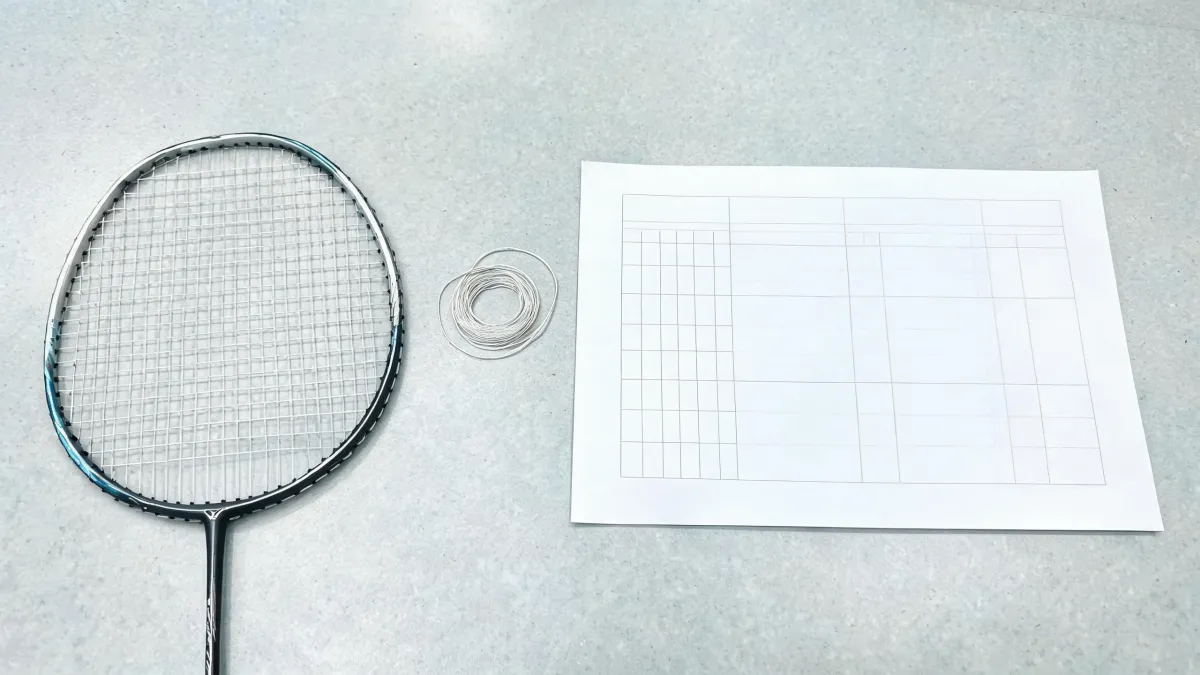
First, name the racket before you ask for anything: model and grip code on the same line, so a later answer cannot drift onto a different frame. Second, write down the checks the sample must let you perform, on the grip build and on the length figure, so the sample has a job instead of an audience. Third, list what the evidence does not answer: quotation, MOQ, lead time, capacity, customization rights on the grip build, and whether your code is available at all. That line is the one everybody forgets, including me, and it is the block that stops an unanswered question from quietly becoming an assumed answer.
Fourth comes the record sheet, frozen before the sample moves, so nobody invents columns under pressure. Last is the review and decision slot, booked with a named owner and a date. The final two are the ones I have watched slip: the sample travels, everyone has an opinion in the meeting, and the form that was supposed to constrain the conversation was never actually fixed.
The One Decision Each Step Must Lock
Identity is what the first step locks. Once the reference sits on the form, any answer that names a different frame is visible on the page rather than buried in a thread. The second step locks the question type: each item is either a check the sample lets you make or a question the supplier must answer on paper, never a feeling. Provenance is the third lock, and it means every line carries one of three marks, documented, asked or still open.
Blanks are the fourth. A field that can only be filled by opinion stays empty, and stays empty right through the meeting. Accountability is the fifth, which in practice means one name and one date rather than a department. I checked a draft handoff for an unrelated program and found two lines reading 'grip feels fine' with no name against them; that is the sentence this order exists to keep out.
How You Confirm a Step Is Done
A step is done when a second person can read the record and reach the same next action; if they cannot, it was discussed, not completed. That is why the record is a written artifact and not a recollection, and why an unfilled line still carries information: anyone can see it is unfilled, which is more than you can say for an assumption nobody wrote down.
The condition-of-part line can cite the manufacturer directly, inside the model scope of this page. The saved product-safety text says to check the grip for wear, gives a slippery grip and rubbed-away grip material as examples of that wear, and states that a worn-out grip can cause the racquet to fly out of one's hands and injure the user or others. That is the manufacturer's own wording and its own stated consequence, tied to the reference model and page, and I quote it here rather than stretching it into a test procedure, because I have no test report for this program.
What I do with that quote is deliberately narrow. The handoff form gets a condition line for the grip as received, and that line points back to the manufacturer's check. Whether a given sample passes is a judgment your QC team makes against whatever standard your program adopts, and this article does not set that standard.
When a Grip Sample Stops Answering the Question
The same saved safety page sets a wider condition. It says it is important for players to choose racquets made for their level of physical strength and play style, and that using racquets made for a target audience different from one's own can often result in injuries. Read next to the grip question, that sentence puts a ceiling on what a grip-only handoff can decide. Grip code lines answer a narrow question about a handle. They do not answer whether this racket suits the players you are buying for.
So the form needs one more line, naming the strength level and play-style target the sample is being judged against. That line has nothing to do with the grip itself, and it is the one most likely to be left blank, because it asks someone to commit to a buyer profile rather than a preference. Suppose a sourcing team ships grip samples to a rep, collects comments and approves the program without ever writing that target down. However good the sample felt, the approval then rests on a conversation nobody can reconstruct, and the manufacturer's point about target audience has been quietly skipped.
The boundary runs the other way too. A grip-fit handoff is not a performance test, not a durability test, not a safety certification and not a substitute for a player holding the racket. It is a paperwork procedure that forces specific questions into a written record before money moves. Treating it as more than that is how a clean-looking form ends up standing in for evidence it never contained.
If what you want is a verdict on how a grip feels in someone's hand, this handoff will disappoint you, so go and hold the racket. It is for the team that opens the form on Monday, writes the model line and the code line for the 88 D GAME, leaves the supplier-meaning line blank, and refuses to close it until something comes back in written form. The blank is the procedure. Everything else on the sheet exists to keep it blank until it is earned.
