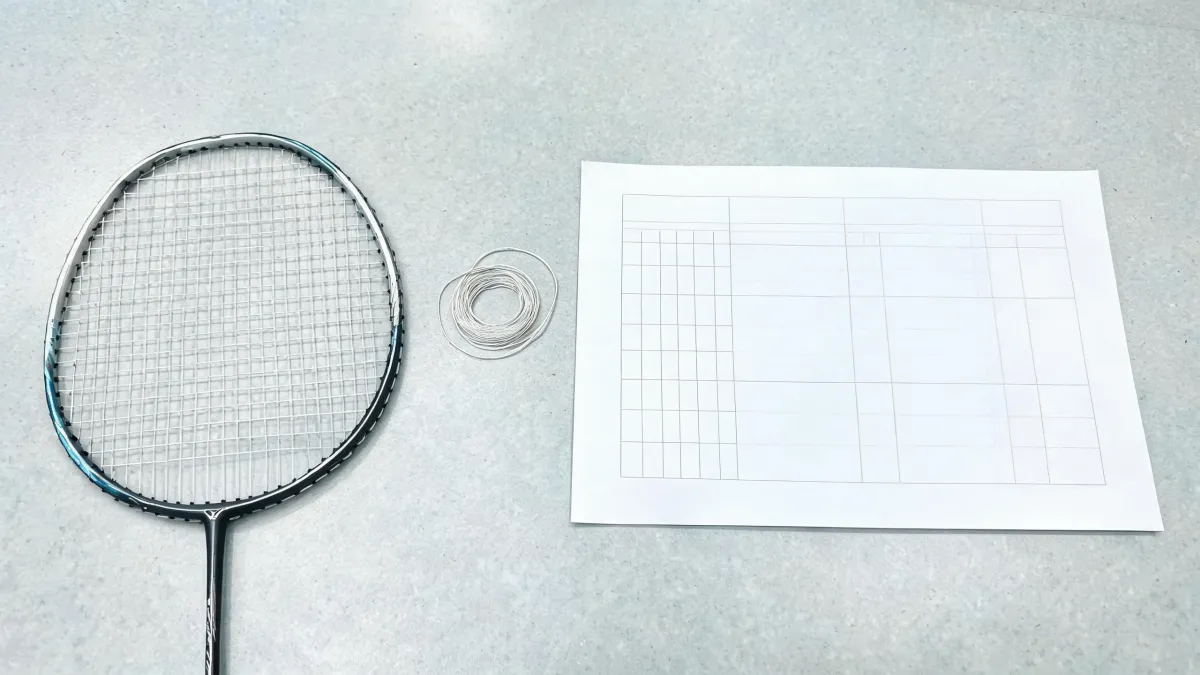
Imagine two draft purchase order lines side by side: Line A reads "string at 26 lb," and Line B reads "20-28 lb, 4U, YONEX ASTROX 88 D GAME 3AX88D-G, mains and crosses per the 3AX88D-G diagram." Both are one sentence long. Only the second is a specification. Line A is an open promise: any frame, any weight class, any tie-off position, and a supplier who ships a 26 lb stringbed has met every word of it. Line B can be checked, rejected or accepted against something the supplier does not control.
The scope label matters more than the length of the sentence. Everything below belongs to YONEX ASTROX 88 D GAME 3AX88D-G as published on its model page and to nothing else - not the wider ASTROX line, not a supplier's own mold, not a private-label frame that borrows the look. No quote, MOQ, lead time, capacity figure, custom authority or sample result exists for this sourcing job yet, so read the numbers as the model's published limits and read anything a supplier says as unanswered until it comes back in writing.
A Bare Tension Line vs a Bound One
Look at what each line leaves open. "String at 26 lb" fixes a single variable and hands the rest to whoever holds the machine. Which frame? Which weight class? Which grommets get skipped, and where does the knot land? A supplier working to that sentence has no target to miss.
Each piece of the bound line closes a hole the others leave open. The range comes off the model page, which lists stringing advice for 4U at 20-28 lb, so the number stops being a preference pulled from a forum thread. The 4U tag matters because the advice is stated for that weight class rather than as a blanket figure. The model and item code 3AX88D-G pin the frame, since tension and tie-off positions travel with the frame and not with the string. The diagram reference pins the string path, which is the part a buyer can physically inspect on a delivered sample.
Now read both lines a year later, when the pallets land and someone has to decide whether to accept them. Line A gives you one check: is the stringbed at 26 lb. Line B gives you tie-off points, a weight marking and a pattern to hold against a drawing you already own. One line can be argued with. The other can be tested. Both drafts are example wording I wrote for this article, not a quote from any factory.
What the 3AX88D-G Sheet Actually Fixes
The page is short and specific. The spec block names ASTROX 88 D GAME, item code 3AX88D-G, stringing advice 4U: 20-28 lb, weight and grip 4U (average 83 g) in G5 and G6, medium flex, a frame of HM Graphite, CSR and Tungsten, a shaft of HM Graphite with 2G-NANOMESH NEO, a built-in T-joint, length 10 mm longer with no absolute length given, and colors Black and Silver.
Those details are what make the tension advice usable in a purchase order. The weight class and the frame construction sit in the same table as the 20-28 lb line, so a buyer can quote the whole block instead of lifting one number out of it. Lift the number alone and the sentence loses the conditions that made it mean anything. The page covers this model and this stored version; it says nothing about another frame in the line, an OEM build, or a revision made after the page was captured.
I would write the block into the spec, never the summary of the block. A document that puts 20-28 lb on page one and 4U, 3AX88D-G, medium flex and built-in T-joint three pages later contradicts itself the moment a supplier quotes a different weight class. Keep them together, in one line or one table cell, whatever format the RFQ uses.
Tie-Off Points Travel With the Frame
Mains start at top center and run until B9, with A7, A9 and A11 skipped. The string then goes through B12, directly to A16, straight to A14, down to B10, and ties off at B8, with the opposite side repeating the same procedure. Crosses are knotted at B6, started from B9, run until A7 with A12 and A10 skipped, then go directly to A5 and tie off there.
Those letters are the whole handoff. Spoken instructions lose exactly the parts that matter: "skip a few on the mains" survives a shift change, "skip A7, A9 and A11" does not. A stringer working from memory can produce a perfectly tensioned stringbed with the knot on the wrong grommet, and the frame will still look right in a photograph. This is why the routing has to sit in the specification beside the tension range instead of in a technician's head, and why the diagram gets attached rather than described. The tie-off at B8 is either where the drawing says or it is not, and that comparison needs no strung frame to make.
The Sample Check I Would Run First
Suppose I hand a supplier the model page and the routing diagram and ask for one strung sample per weight class they can actually supply, with no phone call and no coaching. The hypothesis is narrow: a shop that can reproduce the B8 tie-off and the B6 knot from the sheet alone does not need a conversation to get there. No result exists for this order, so nothing here is a measurement I took - it is the check I would run first.
The method is paperwork plus one frame. Send the sheet, the diagram and the spec line, then record four things when the sample comes back: tie-off points against the diagram, the model and weight marking on the frame, the string set actually used, and the stringbed tension read on the shop's own gauge with the calibration date written beside it. Reject the sample when a tie-off lands on the wrong grommet or the weight marking does not match the class quoted. A sample that passes on pattern but arrives with an unmarked frame is not a pass; it is an unfinished check.
Spec Sheet Compared With a Chat Message
I have handled both handoff formats in sourcing review, and the difference shows up months later, not at the bench. One is a written line in the spec pack: 20-28 lb, 4U, 3AX88D-G, routing per the diagram. The other is a chat message to the stringer saying "do it like last time." The chat version is faster than the sheet, no argument there - four seconds to send, no document control, nobody has to approve a revision. Compared with the sheet, though, it leaves nothing to hold against the tie-off diagram when a sample lands on your desk six weeks out. Unlike a spec line, a chat message dies with the phone it was typed on; change stringers, change shifts, change factories, and the instruction is gone. Both carry an instruction. Only one carries a record, and on auditability the sheet wins hands down. That verdict is about paperwork, not about anyone's skill at a machine - I have watched careful stringers rebuild a pattern from a photograph, and I have watched careless ones miss a skip point with the sheet lying open in front of them.
When 20-28 lb Stops Being the Right Number
Scope breaks in predictable places. A weight class other than the 4U figure quoted here sits outside the advice, because the page states 20-28 lb for 4U and does not offer one figure for the frame in any build. A different model - another frame in the same line, a supplier's own geometry, a private-label shell - carries its own numbers and its own routing, and borrowing this block for it turns a spec sheet into a guess. Custom paint or a grommet change can move the tie-off positions; once the supplier's frame no longer matches the diagram, the routing reference stops being a check and becomes decoration. A string type or gauge the stored page does not address stays an open question rather than an invitation to keep the range. A supplier who will not confirm the routing in writing has handed you a verbal promise with a number attached. None of these voids the 20-28 lb advice for this model. Each one voids your right to quote it for something else.
The live gaps on this order are procurement facts, not technical ones: no quote, no MOQ, no lead time, no capacity confirmation, no statement of custom authority and no strung sample. Those sit on the buyer's open list until a supplier answers them in writing.
Rewrite One Line Before You Send the RFQ
Rewrite the line before the RFQ goes out. Replace the free-floating pound number with five elements in one sentence: the 20-28 lb range, the 4U weight class, the model and item code 3AX88D-G, a reference to the mains and crosses routing on the model diagram, and a sample-approval clause that makes a strung sample a condition of the first bulk release. Then put three questions to the supplier in writing. Can you confirm the 3AX88D-G mains and crosses routing as drawn, including the knot at B6 and the tie-off at B8? Which weight classes can you actually supply, and does your tension advice change for any of them? Will you string a sample before bulk and send the string set and the measured stringbed tension with it?
These are purchasing questions and acceptance items, not instructions for anyone to string anything. If all three come back specific, you hold a line you can enforce against a sample. If any answer stays vague, the line stays open and the order waits. That is the whole test, and it costs one email today.
